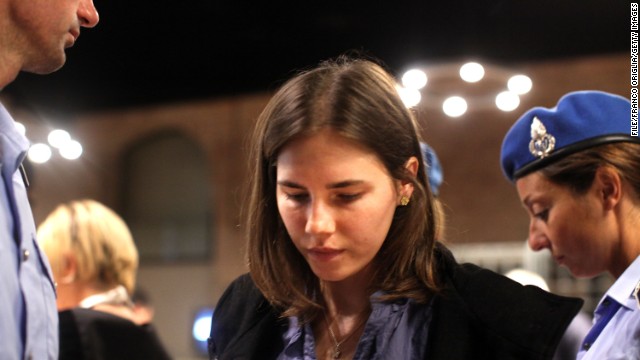
STORY HIGHLIGHTS
- Nadeau: Only guarantee in Kercher murder trial is that new result will cause outcry
- Amanda Knox's lawyer believes Knox will not attend trial and will be tried in absentia
- U.S. has declined to respect extradition treaty with Italy in the past
The scene in the Italian
courtroom on Tuesday morning was oddly reminiscent of verdicts past in
the complicated case, with the exception of two missing characters: Knox
and Sollecito. The rest were there, including the lawyers who defended
the two former lovers and the lawyers who represented the family of the
victim -- and of course the hoard of television cameras who had come for
the latest installment of the seemingly endless saga.
Kercher, who shared an
apartment with Knox in Perugia near the University for Foreigners, was
stabbed in her bedroom and left for dead on November 1, 2007. Her
autopsy showed that she choked on her own blood. She had not been raped,
according to her autopsy, but she was found partially nude, adding an
element of mystery to the case that laid the groundwork for what would
become a theory that Kercher died as part of a "sex game gone wrong."
The door to her bedroom was locked from the inside and pulled closed.
 Amanda Knox ordered to stand trial again
 Knox's lawyer: We're ready to fight
 Knox's ex: We're like brother, sister
There were no
fingerprints on the outside of the door and scant blood in the rest of
the house, which eventually led to the theory of a cleanup. Rudy Guede,
an Ivory Coast native who was raised by a local family in Perugia, was
the first to be found guilty of the crime in a fast-track trial in 2008.
His conviction was upheld on appeal but his sentence was reduced from
30 years to just 16 years.
Knox and Sollecito were
initially found guilty in connection with Kercher's murder, but were
ultimately acquitted two years later on appeal. Knox went home to
Seattle to finish her studies at the University of Washington. Sollecito
moved to Verona to take up studies in robotic surgery. The case seemed
to be over. For most people, especially those of us who followed the
case closely, the high court hearing was supposed to be just a formality
-- they would confirm the acquittal and we could all go home and put
the case to rest.
Now everything is up in
the air again. Italy's highest court decided to reject the acquittal in
its entirety and send the case back to a panel of appellate judges to
reconsider. What that means in practical terms is nothing short of a
complicated, confusing mess. When Knox was first convicted of murder,
there was outcry in the United States that she was wrongfully convicted,
based on shoddy evidence collected by sloppy Italian police. When she
was acquitted two years later, there was nearly as much of an outcry in
Italy that the courts had succumbed to American pressure. Now, the
outcome is again uncertain, with the only guarantee that whatever
happens, it will again cause an outcry -- it's just not clear yet by
whom.
But even though retrying
the case may seem something like déjà vu, there is going to be one stark
difference. Knox will not be in court this time around. During the
first trial in which she was convicted and the appeal in which she was
acquitted, she was the star of the show that drew the masses to court
each week. Her lawyer, Carlo Dalla Vedova, believes Knox will not attend
and will be tried in absentia this time.
Without her presence, it remains to be seen whether the media will be as interested.
Even if Knox is
convicted this time around, it is unlikely she will ever come back to
Italy. There is a valid extradition agreement between the two nations,
but the U.S. has not set much of a precedence in returning suspects for
such matters. In 1998, an American fighter jet clipped a ski lift cable
sending a gondola of 20 passengers to their death in the Italian
Dolomite mountain range.
Italy had requested
their extradition to try them for multiple manslaughter, but the U.S.
refused and tried them in a military tribunal instead. They were found
not guilty.
And in 2012, Italy's
high court upheld the conviction of 22 CIA agents and an Air Force
colonel in conjunction with the extraordinary rendition of Egyptian
cleric Abu Omar from a street in Milan. Again, the U.S. refused to
comply with the extradition order. Both previous high-profile cases
involved state employees or military members. Knox's case is a private
matter with very little precedence.
Knox may be safe in
Seattle, but her erstwhile boyfriend is far more vulnerable here in
Italy. By the same law that protects Knox, Sollecito is also free to
skip the retrial. But because he is an Italian citizen, he will not have
to face extradition if reconvicted.
The police can simply
pick him up and put him in jail. Sollecito's father attended the high
court hearing on Monday but he was not present for Tuesday's verdict. He
has staunchly defended his son's innocence, but it remains to be seen
if he supports having him stay here in Italy for the retrial.
The only people who
expressed relief at Tuesday's verdict and news of the retrial were
Kercher's family. Their lawyer Francesco Maresca said they felt that
now, finally, "justice might be served."
When Knox was acquitted
of the murder in 2011, the Kerchers were left flabbergasted and
disappointed by the reversal. "We respect the court but we had hoped for
a different outcome," Kercher's mother told me the day Knox was set
free.
Meredith's brother Lyle
said that he felt the wounds had been left open. "We haven't really had a
chance to properly grieve," he said at the time. "We accept the
decision and respect the court. But now we are left looking at this
again. We really are back to square one." No matter how the case
ultimately ends, there will likely always be far more questions than
answers.

No comments:
Post a Comment
what do you think?